
Sntieecr STEM Electric Circuit Motor Kit
4.2Editor score
Affordable entry price
Includes motors and bulbs
Basic circuit components
Good for simple experiments
This guide compares the top electricity learning kits for students and hobbyists, evaluating features, safety, educational value, and ease of use for hands-on
Electricity learning kits provide an engaging way for students to explore the fundamental principles of physics and engineering through hands-on experimentation. These kits typically include components like wires, bulbs, and switches to build real circuits.
We evaluated ten top-rated kits based on their component variety, instructional quality, safety features, and suitability for different age groups. Each product was reviewed for its ability to foster curiosity and practical understanding of electrical concepts.
Every pick highlights specific strengths such as project variety, durability, and educational depth. Keep in mind that availability and pricing may vary by region and time, so check current listings before purchasing.
4.2Editor score

4.7Editor score

4.5Editor score
The following table provides a side-by-side comparison of all ten selected electricity learning kits. It highlights key specifications to help you choose the right kit for your educational goals and experience level.



The National Geographic Circuit Kit stands out as a top choice for young learners with over 120 projects to explore. It holds a strong 4.7 rating for its engaging design and comprehensive approach to electricity education.
We may earn a commission when you buy through this link, at no additional cost to you.
This kit excels in safety and ease of use, featuring snap-on components that require no tools. The inclusion of QR codes linking to video instructions ensures that children can learn effectively with minimal frustration.
While the price is higher than basic kits, the value provided through the sheer number of projects justifies the cost. Some users might find the sheer volume of activities requires significant time to complete.
Ideal for students aged 8 and up who want a long-term learning tool, this kit is recommended for parents seeking a premium educational experience. It fosters curiosity and creativity through safe, hands-on exploration.
With over 120 projects, kids can explore everything from light shows to sound systems, keeping them engaged for hours of continuous learning and discovery.
The snap-together components eliminate the need for tools, reducing risk and making it simple for children to build and modify circuits independently.
We may earn a commission when you buy through this link, at no additional cost to you.
The Sntieecr STEM Electric Circuit Motor Kit offers an affordable entry point into electronics education with essential components like motors and bulbs. It rates 4.2 for its simplicity and practicality for young experimenters.
We may earn a commission when you buy through this link, at no additional cost to you.
This kit includes basic materials needed for simple projects, making it ideal for introductory lessons. The low cost allows for easy access to hands-on learning without a significant financial commitment.
Users should note the voltage limitations and the need for adult supervision to avoid overheating. While not as advanced as other kits, it serves well for foundational understanding.
Best suited for budget-conscious parents or teachers needing a starter set, this kit is recommended for simple classroom activities. It provides a practical way to introduce circuit concepts safely and efficiently.
Priced significantly lower than premium kits, this set allows families to introduce electricity concepts without a large upfront investment in expensive equipment.
Unlike basic light kits, this set includes motors, enabling kids to explore mechanical applications of electricity and understand how power drives movement.
We may earn a commission when you buy through this link, at no additional cost to you.
The EUDAX School Physics Labs kit is designed for high school students, offering advanced experiments including magnetism and electromagnetism. It holds a 4.5 rating for its academic depth and comprehensive content.
We may earn a commission when you buy through this link, at no additional cost to you.
This premium kit features detailed manuals and a wide range of components to build complex models like generators and electric bells. The inclusion of magnetism experiments adds significant educational value.
While excellent for older students, it may be too complex for younger children. Additionally, users need to provide AA batteries, which are not included in the package.
Ideal for high school physics enthusiasts or educators, this kit is recommended for serious study. It provides a robust platform for understanding both electricity and magnetism through rigorous experimentation.
Targeted at grades 9 to 11, this kit aligns with high school curricula, offering deep dives into electromagnetism and circuit theory beyond basic lights and motors.
Including specific experiments for magnetism and electromagnetism, this kit bridges the gap between electricity and magnetic fields, enhancing physics understanding significantly.
We may earn a commission when you buy through this link, at no additional cost to you.
The STEM Electric Circuit Kit provides a focused set of experiments, including fun fruit battery and saltwater power projects. It rates 4.5 for its ability to make abstract concepts like energy generation concrete.
We may earn a commission when you buy through this link, at no additional cost to you.
This kit promotes critical thinking by guiding kids to solve problems through circuit building. The engaging circuit book helps learners understand the theory behind the hands-on activities effectively.
Although it offers fewer projects than some competitors, the quality of instruction and unique energy experiments compensate for the count. Users should ensure they have AA batteries ready for the sessions.
Best for young learners interested in renewable energy concepts, this kit is recommended for science fairs and school projects. It offers a balanced mix of education and entertainment for ages 8 to 14.
By including fruit and saltwater power generation, this kit introduces kids to alternative energy sources, sparking interest in sustainability and green science.
The detailed circuit book acts as a structured guide, ensuring that each experiment builds on previous knowledge to reinforce learning outcomes effectively.
We may earn a commission when you buy through this link, at no additional cost to you.
The Mysterystone Science Experiment kit offers over 50 unique projects including advanced modules like Joule's first law experiment. It holds a 4.4 rating for its comprehensive approach to physics education.
We may earn a commission when you buy through this link, at no additional cost to you.
This kit stands out for its solid storage case and detailed manual that explains the science behind every experiment. It encourages students to design their own projects beyond the manual's scope.
While powerful, the variety of components may be overwhelming for absolute beginners. Users should note that batteries are required and not included with the kit.
Ideal for students ready to move beyond basic circuits, this kit is recommended for those seeking a deeper dive into physics. The organized storage case makes it easy to transport and store components safely.
With specialized modules for concepts like Joule's law, this kit provides advanced learning opportunities that are rare in standard electricity kits.
Every item has a fixed place in the solid storage case, ensuring components stay organized and easy to find for repeated experiments.
We may earn a commission when you buy through this link, at no additional cost to you.
The Teenii Electricity and Magnetism Kit is designed to foster family interaction through science, featuring 18 hands-on experiments. It rates 4.4 for its comprehensive component set and parental engagement focus.
We may earn a commission when you buy through this link, at no additional cost to you.
This kit includes specialized tools like an ammeter and voltmeter, giving kids a realistic look at how circuits are measured in real-world scenarios. The detailed manual supports both kids and parents.
While engaging, the assembly of 18 experiments requires time and patience. It is best used during dedicated learning sessions rather than quick play.
Best for families looking to learn together, this kit is recommended for fostering critical thinking and curiosity. It serves as an excellent gift that encourages active participation from both parents and children.
Designed to encourage shared activities, this kit allows parents to guide and learn alongside their children, strengthening bonds through shared scientific discovery.
Including functional ammeters and voltmeters gives children a practical understanding of how professionals measure electrical current and voltage in real systems.
We may earn a commission when you buy through this link, at no additional cost to you.
The Physics Labs Basic Electricity Kit is tailored for junior high students, offering a mix of electricity and magnetism experiments. It holds a 4.5 rating for its curriculum-aligned content and detailed instructions.
We may earn a commission when you buy through this link, at no additional cost to you.
This kit includes unique components like a magnetically controlled switch, providing advanced concepts for curious minds. The double-layer storage box ensures all parts are organized and protected.
Users need to provide three AA batteries to operate the kit, which is a minor inconvenience. Despite this, the educational value provided by the comprehensive manual is high.
Ideal for school-aged students needing a structured learning tool, this kit is recommended for physics classes. It effectively bridges the gap between theoretical knowledge and practical application in a safe environment.
Designed specifically for junior and senior high school students, this kit matches classroom topics, making it a useful supplement for formal science education.
The double-layer storage box keeps all 77 items in fixed positions, reducing the risk of lost parts and simplifying setup for repeated experiments.
We may earn a commission when you buy through this link, at no additional cost to you.
The EUDAX Physics Science Lab Basic Kit provides a safe and simple introduction to electricity for younger students. It rates 4.6 for its straightforward design and helpful English language manual.
We may earn a commission when you buy through this link, at no additional cost to you.
This kit focuses on building series and parallel circuits, helping students consolidate textbook knowledge through practice. The plastic storage box keeps everything tidy and portable.
While excellent for basics, it lacks advanced components found in higher-tier kits. Users must remember to provide two AA batteries to make the circuits functional.
Best for 7th to 9th graders starting out, this kit is recommended for home school units and summer camps. It provides a solid foundation for future studies in electronics and physics.
Instructions are clear and written in English, making assembly and learning accessible for students without language barriers or complex technical jargon.
All accessories fit into a durable plastic storage box, allowing for easy transport to and from science clubs or classroom presentations without loss of parts.
We may earn a commission when you buy through this link, at no additional cost to you.
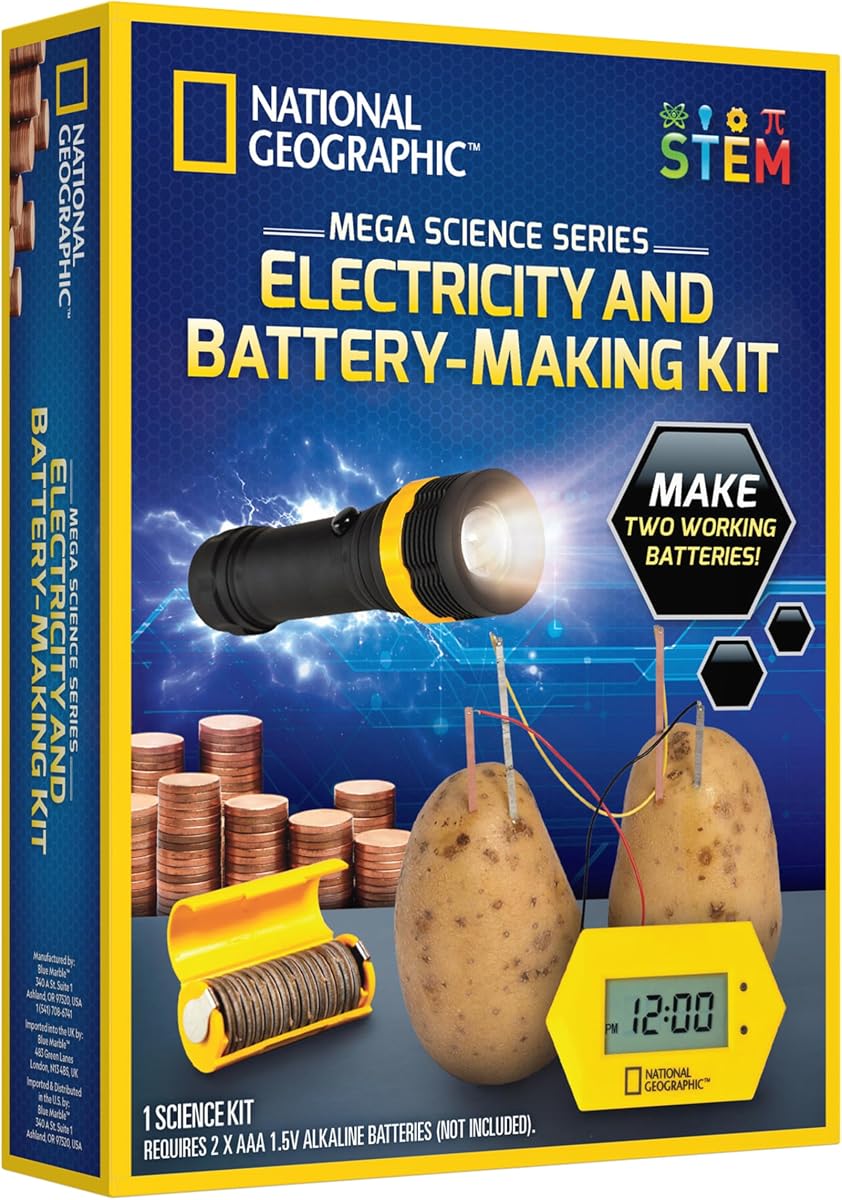
The National Geographic Battery Making Science Kit teaches kids about power generation through fun projects like a potato clock. It holds a 4.5 rating for its unique approach and engaging content.
We may earn a commission when you buy through this link, at no additional cost to you.
This kit focuses specifically on how batteries work, using items like potatoes and coins to create circuits. The detailed learning guide provides deep insights into electrical engineering basics.
While the project count is low compared to others, the quality of the experiments ensures focused learning. The requirement for food items like potatoes might need kitchen prep.
Ideal for curious kids who want to see how batteries work, this kit is recommended as a supplemental science gift. It offers memorable hands-on learning that stands out from standard circuit building.
Unlike general circuit kits, this focuses on energy storage and creation, teaching children how chemical energy converts to electrical power through real examples.
Backed by a prestigious award, the kit is developed with high educational standards, ensuring that the experiments are both safe and scientifically accurate.
We may earn a commission when you buy through this link, at no additional cost to you.
The EUDAX Upgrade Kit builds on the basic set with advanced components like LEDs and switches. It rates 4.4 for its improved features and readiness for complex projects.
We may earn a commission when you buy through this link, at no additional cost to you.
This kit enables building advanced setups like traffic lights and wind power cars, expanding learning possibilities. The transparent storage box allows for quick inventory checks of components.
Users need to provide two AA batteries as they are not included. The complexity is suitable for teachers and older students aiming for more sophisticated models.
Best for educational settings needing advanced options, this kit is recommended for teachers and schools. It offers a balanced upgrade that adds significant functionality for a reasonable price.
With added LEDs and switches, this kit supports more complex builds like traffic lights, allowing students to visualize advanced circuit logic clearly.
The transparent storage box makes it easy to see available parts at a glance, saving time on setup and ensuring all components are accounted for.
We may earn a commission when you buy through this link, at no additional cost to you.
Choosing the right kit involves considering the child's age, interests, and educational needs. This section outlines key factors to ensure you select a kit that offers value and engagement.
Select a kit that matches the student's reading level and motor skills. Younger children benefit from snap components and simple lights, while older students may prefer detailed manuals and complex circuits.
Check the age range provided by the manufacturer to ensure safety and engagement.
A higher number of projects keeps learners engaged longer. Look for kits that offer diverse builds like motors, lights, and generators to prevent boredom.
More variety means more opportunities to learn different electrical principles.
Clear manuals with diagrams and explanations are vital for success. Kits with video instructions or QR codes can provide additional support for visual learners.
Good instructions ensure that children can build successfully without constant adult assistance.
Ensure components are durable and safe for children to handle. Look for non-toxic materials and secure connectors that prevent pinching or short circuits.
Safety features protect children during exploration and reduce the risk of accidents.
Choose kits that align with school curricula or specific learning goals. Kits focusing on theory alongside practice help reinforce classroom learning.
Higher educational value means the kit is a useful supplement to formal education.
A storage case helps keep small parts organized and prevents loss. Kits with labeled compartments make setup faster and cleanup easier.
Good storage ensures the kit remains usable over time without losing essential parts.
Check if batteries are included or required. Kits that need standard AA batteries are common, but availability affects immediate use.
Understanding power requirements helps avoid delays in starting experiments.
Kits range from affordable basics to premium sets. Determine how often the kit will be used to decide on an investment level.
A higher budget often buys more variety and durability for long-term use.
Always read the manual thoroughly before starting any experiment to understand the purpose of each component. This preparation helps avoid frustration and ensures a smooth learning process.
Connect components securely before turning on power to prevent short circuits or sparks. Regularly check connections and wires for wear and tear before each session.
Store the kit in a dry, cool place with the storage box closed to protect parts from dust and damage. This care ensures the kit remains functional for years of experimentation.
Most kits do not include batteries due to shipping regulations. You will usually need to provide your own AA or AAA batteries to power the circuits and lights. Check the product details before buying to confirm.
Kits are available for ages 5 to 14 depending on complexity. Younger kids benefit from simple snap circuits while older students can handle detailed engineering projects. Always check the age rating.
Yes, most kits are designed with safety in mind using low voltage and secure connectors. However, adult supervision is recommended for younger children to prevent accidental short circuits.
Absolutely, many of these kits are designed to complement school curricula. They offer the hands-on experience needed for science fairs and classroom assignments effectively.
Most manufacturers offer customer support for replacement parts. Contact the seller if you lose or break a piece to keep your kit functional and complete.
Most modern kits are tool-free, using snap-on connectors for assembly. Some advanced kits might require basic screwdrivers, so check the product specs before starting.
The National Geographic and EUDAX kits stand out for their comprehensive features and educational depth suitable for different age groups. Each option provides unique benefits depending on your specific needs.
Prioritize safety and component quality when selecting a kit to ensure long-term engagement and learning value. Consider your child's interest level to choose between basic or advanced options.
Always check current availability and pricing as these details can change over time. We hope this guide helps you find the perfect kit to spark a love for science.