
3DMakerpro Fox
3.2Editor score
Entry-level scanning
Markerless AI tracking
0.07mm accuracy
3D scanners have transformed how we capture physical objects, turning real-world items into precise digital models. Whether you need reverse engineering, 3D printing, or visual effects, the right scanner ensures high fidelity and efficiency in your workflow.
We evaluated ten leading models based on accuracy, scanning speed, software capabilities, and ease of use. Our analysis focuses on real-world performance across various environments, ensuring you find a device that meets professional and hobbyist standards alike.
Each pick highlights unique strengths, from portable handheld units to industrial-grade systems. Note that pricing and availability may change over time. Always verify current details before purchasing to ensure the best value for your specific application requirements.
3.2Editor score

5.0Editor score

4.5Editor score
As an Amazon Associate we earn from qualifying purchases.
This side-by-side comparison evaluates the top 3D scanners available in 2026. We analyze key specifications, accuracy levels, scanning speeds, and unique features to help you understand how each model performs in real-world scenarios.


The Creality Pika Portable stands out as a top contender in 2026 with its 5.0 rating. This device combines 0.03mm accuracy with dual-mode scanning to handle everything from tiny parts to full-body scans efficiently.
We may earn a commission when you buy through this link, at no additional cost to you.
Its dual blue laser and NIR structured light modes ensure high fidelity on various surfaces. AI features like body completion and hole filling streamline post-processing. Wireless Wi-Fi 6 connectivity allows for unrestricted movement during scanning sessions.
While the price point is higher, the precision and versatility justify the investment. Users benefit from marker-free scanning and direct exports to major formats like STL and OBJ without needing extra software.
If you need a reliable scanner for both hobby and professional use, the Pika is an excellent choice. It delivers consistent results across environments and simplifies complex workflows with smart AI integration.
Switch between laser for fine details and NIR for body scans effortlessly.
Automatic repairs and retexturing save significant time in post-processing.
We may earn a commission when you buy through this link, at no additional cost to you.
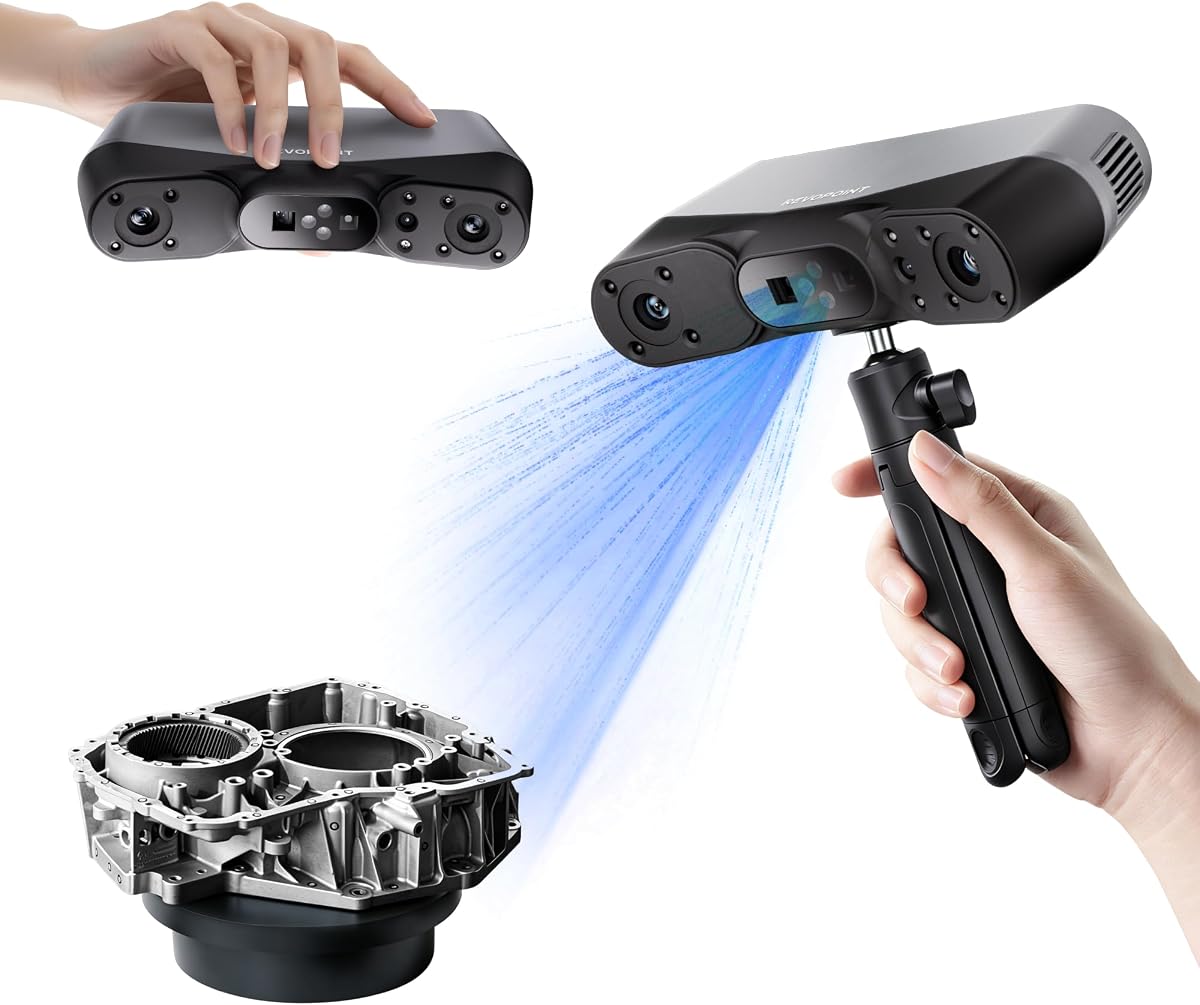
The Revopoint POP 4 offers industrial-grade accuracy suitable for demanding applications. It captures fine details with 0.03mm precision. Its robust frame rate ensures smooth scanning for large objects and complex scenes.
We may earn a commission when you buy through this link, at no additional cost to you.
With five scanning modes, it handles everything from deep holes to reflective surfaces. All-weather performance allows outdoor work under bright sunlight. The battery grip supports extended sessions without tethering to power sources.
Advanced segmentation filters noise effectively for clean data. However, some advanced measurement tools require separate paid software. This may add cost for users needing full CAD integration.
Ideal for engineers and makers needing reliable, high-speed data. The POP 4 balances speed and precision well for reverse engineering and prototyping tasks across various industries.
Operates reliably up to 100,000 lux with appropriate filters.
Converts scans into photorealistic models for gaming or animation.
We may earn a commission when you buy through this link, at no additional cost to you.
The INSPIRE 2 delivers high-quality results with 0.05mm accuracy and a lightweight design. It is ideal for fieldwork where portability matters. Dual modules allow adapting to different materials and sizes easily.
We may earn a commission when you buy through this link, at no additional cost to you.
Infrared laser lines handle dark surfaces without spray. Adjustable optical zoom focuses light for detailed mixed-geometry capture. Real-time streaming to mobile devices improves workflow efficiency significantly.
Users note the outdoor filter is needed for bright conditions. Despite this, the unit is robust enough for varied environments. The included accessories ensure you can start scanning immediately.
Best for professionals needing mobility without sacrificing quality. Its precision supports heritage preservation and product design tasks effectively.
Combines structured light and laser for diverse material handling.
Built-in RGB camera captures lifelike surface textures accurately.
We may earn a commission when you buy through this link, at no additional cost to you.
The MetroY Ultra is designed for industrial inspection and reverse engineering. It delivers 0.01mm accuracy and up to 90 FPS speed for rapid data capture. Blue laser technology handles dark and shiny surfaces without spray.
We may earn a commission when you buy through this link, at no additional cost to you.
Its five modes cover small parts to medium-sized objects efficiently. Wireless control via Wi-Fi 6 and Revo Mirror keeps you mobile. The battery grip supports long field sessions reliably.
This device is ideal where speed and precision are paramount. Users avoid prep time by scanning metallic components directly. Export formats are extensive for industry workflows.
Perfect for manufacturing and quality control needs. It balances high-end specs with usability for professional teams.
Rapid scans using laser cross-lines reduce acquisition time significantly.
Advanced optics capture complex surfaces without additional coating.
We may earn a commission when you buy through this link, at no additional cost to you.
The MetroX Pro excels with 0.01mm single-frame precision for complex parts. Blue laser modes handle high-reflectivity metals. Real-time streaming allows viewing scans on secondary devices for better alignment.
We may earn a commission when you buy through this link, at no additional cost to you.
Auto turntable scanning simplifies work for round or symmetric objects. It captures color-accurate scans with its HD RGB camera. Data exports seamlessly to measurement and CAD tools.
Ideal for users needing top-tier metrology without bulky setups. The interface is intuitive, making it accessible. Paid software options enhance reverse engineering capabilities.
A solid choice for industrial design. It meets demanding specs for quality inspection and prototyping needs.
Automated scans for symmetric objects simplify repetitive tasks.
Monitor progress on mobile devices for efficient workflow.
We may earn a commission when you buy through this link, at no additional cost to you.
The Fox is designed for beginners and hobbyists seeking medium-format capabilities. It offers 0.07mm accuracy at a budget-friendly price. Markerless AI tracking helps recover from mistakes easily.
We may earn a commission when you buy through this link, at no additional cost to you.
JMStudio software integrates scanning and editing into one process. It handles everyday objects well for 3D printing. Users can print models without extensive post-processing.
While not industrial-grade, it suits small projects effectively. The tracking ensures smooth handheld use. It is a great entry point into professional scanning.
Best for those on a budget. It balances cost and capability for home users and small workshops.
Relocks onto objects quickly if movement disrupts the scan.
Streamlined software simplifies post-processing for new users.
We may earn a commission when you buy through this link, at no additional cost to you.
The Otter Lite captures objects from coins to cars using quad cameras. It reaches 78 inches in range for large projects. Eye-safe infrared allows face and full-body scans safely.
We may earn a commission when you buy through this link, at no additional cost to you.
DOE technology handles metallic and dark surfaces without powder. It exports widely for 3D printing and design. CrealityScan software offers head mesh repair features.
Ideal for automotive and full-body applications. Speed and color fidelity make it versatile. Users appreciate the ease of scanning large assets.
Best for makers needing large-format capability. It simplifies full-body and machinery scans effectively.
Combines lenses for fine detail and broad coverage.
RGB camera with LED fill ensures vibrant texture capture.
We may earn a commission when you buy through this link, at no additional cost to you.
The CR-Ferret SE is an accessible handheld option for beginners. Anti-shake tracking ensures smooth scans even with hand movements. It captures colors vividly for realistic models.
We may earn a commission when you buy through this link, at no additional cost to you.
It handles black and metal objects without spray. Flexible ranges suit medium-sized items. Its design prioritizes ease of use for casual applications.
While precision is limited compared to pro units, it suffices for general modeling. The cost-effective approach makes scanning accessible to hobbyists.
Ideal for home users needing basic functionality. It balances usability and affordability for 3D printing projects.
Enhanced tracking reduces error rates during movement.
High-resolution camera captures intricate colored details.
We may earn a commission when you buy through this link, at no additional cost to you.
The Ferret Pro adds wireless capabilities via WiFi 6 bridge. It maintains 0.1mm accuracy and 30FPS speed. Anti-shake ensures smooth handheld operation for beginners.
We may earn a commission when you buy through this link, at no additional cost to you.
It supports iOS and Android devices for mobile workflows. Outdoor performance is reliable up to 30,000 lux. Users benefit from easy file exports and compatibility.
While not industrial-grade, it offers robust features for general use. The bridge enables freedom from cables. It suits dynamic scanning environments well.
Ideal for mobile workflows and quick tasks. It bridges the gap between basic and advanced handheld scanning.
Three times faster data transfer than previous generations.
Supports Android and iOS for flexible scanning options.
We may earn a commission when you buy through this link, at no additional cost to you.
The MIRACO Plus combines scanning and photogrammetry in one unit. It features a 48MP camera and onboard processing for independence. Its hardware supports complex tasks without external PCs.
We may earn a commission when you buy through this link, at no additional cost to you.
The flip screen allows real-time viewing from any angle. Photogrammetric kits ensure length accuracy for large objects. It supports a wide range of formats for export.
Ideal for professionals needing an all-in-one solution. It streamlines workflows for product design and reverse engineering. The battery life supports portable field use.
Best for advanced users requiring high integration. It delivers top-tier performance and flexibility.
Captures small details on large objects with high accuracy.
8-core processor and RAM allow standalone operation.
We may earn a commission when you buy through this link, at no additional cost to you.
Choosing the right 3D scanner requires understanding your needs and technical requirements. This guide covers key factors to ensure you invest in a device that delivers value and performance.
Accuracy determines how closely the digital model matches the physical object. For industrial or medical use, look for 0.03mm or better. Hobbyists may accept slightly lower precision to save costs.
Prioritize models that maintain consistent accuracy across different scanning conditions.
Speed impacts workflow efficiency. Faster frame rates (like 90 FPS) allow for real-time preview and quick data capture. Slower speeds may be acceptable for static objects.
Check specs for frames per second to understand throughput.
Dark, shiny, or transparent surfaces can be difficult to scan. Technologies like structured light or dual laser modes help avoid the need for spraying powders.
Look for 'No-Spray' claims in product descriptions.
If you need to scan outdoors or at various locations, wireless support like Wi-Fi 6 and battery life matter. Lightweight designs reduce fatigue during long sessions.
Ensure the device supports mobile or cloud connectivity if needed.
Post-processing software is crucial for cleaning and aligning data. Some systems include free tools, while others require paid licenses for advanced features like CAD export.
Verify software compatibility with your operating system.
Determine the typical size of objects you need to scan. Some scanners handle small parts, others large machinery. Dual-range modes offer more flexibility.
Ensure the scanning volume fits your project needs.
Prices vary widely from entry-level to industrial-grade. Set a clear budget but consider total cost including software or accessories.
Balance features with affordability to avoid overspending.
Look for devices with firmware updates and active support. This ensures longevity and compatibility with future software versions.
Choose brands with strong community and documentation support.
Start by calibrating your scanner using the provided board. This ensures accurate spatial mapping for all scans. Follow manufacturer instructions for initial setup.
Clean the lenses and sensors regularly with a soft cloth. Avoid harsh chemicals that might damage optical coatings. Store the device in a dry place to prevent moisture damage.
When scanning complex objects, ensure lighting conditions are stable. For handheld units, move steadily to avoid gaps. Export files in widely compatible formats for easy editing.
The 3DMakerpro Fox is highly recommended for beginners due to its affordable price and easy-to-use software. It offers sufficient accuracy for hobbyist projects without a steep learning curve.
While many devices connect to PCs for processing, some all-in-one models like the MIRACO Plus can operate independently. Always check system requirements before purchasing to ensure compatibility with your devices.
Advanced models with laser or structured light technology can scan dark and shiny surfaces without spray. However, basic models may still require a light powder coating to achieve good results.
Handheld units typically range from 0.1mm to 0.01mm accuracy. Professional-grade models offer tighter tolerances, making them suitable for precision engineering. Entry-level models are sufficient for general 3D printing.
Most devices export common formats like STL, OBJ, PLY, and ASC. These ensure compatibility with major CAD and printing software. Some offer proprietary formats for advanced users.
Yes, several models offer outdoor capabilities with resistance to ambient light. Look for devices with filters or strong laser capabilities to handle sunlight effectively without losing accuracy.
Our top picks highlight the Creality Pika for overall performance, the 3DMakerpro Fox for budget buyers, and the Revopoint MIRACO Plus for professionals. Each offers distinct strengths tailored to different needs.
Prioritize accuracy and software compatibility when selecting a device. Ensure the scanner fits your typical workload and environment. Balancing features with usability will yield the best long-term value.
Prices and availability can fluctuate. Always verify current offers before purchasing to get the best deal. Invest wisely to maximize your productivity and creativity.