
Donner Amp Attenuator Pedal
4.3Editor score
Clear sound circuit design
True bypass FX loop integration
Mute footswitch included
Discover the top attenuators for tube amps that let you play loud tones at low volumes while preserving tone dynamics and speaker interaction.
Tube amplifiers deliver rich harmonic overtones and natural compression that many players crave. However, driving them to their sweet spot often requires volumes that are impractical for home or studio use. An attenuator solves this by absorbing excess power so you can crank the amp safely.
This guide compares ten leading attenuators ranging from simple passive boxes to advanced reactive load systems. We evaluated build quality, tone preservation, feature sets, and value to help you find the right match for your rig and budget constraints.
Each pick includes detailed specs, pros, and cons to show exactly what to expect from every model. Remember that prices and availability fluctuate frequently, so verify current details before making your final purchase decision today.
4.3Editor score

4.3Editor score

4.4Editor score
The following table provides a side-by-side comparison of all ten attenuators included in this guide. Review the key specifications and features to quickly identify which unit matches your amplifier type and intended use case.



The Bugera POWER SOAK PS1 stands out as a reliable solution for guitarists and bassists needing to tame their amplifier output. With a rating of 4.3 stars it delivers consistent performance across various amp configurations. Its passive design ensures no power supply is required making it easy to integrate into any rig.
We may earn a commission when you buy through this link, at no additional cost to you.
Its standout quality lies in the multi-impedance input connectors supporting 4 8 and 16 ohm loads. This flexibility allows users to match virtually any amplifier without needing adapters. The emulated mic output is a significant bonus enabling direct recording without needing a physical microphone setup.
One honest trade-off is the lack of active features like boost or variable attenuation levels beyond the line output control. While this limits fine-tuning options it ensures signal integrity and reduces potential noise sources. This simplicity is often preferred by players who prioritize tone over complex control.
Anyone seeking a robust power attenuator that handles high wattage safely will find this unit ideal. It is particularly suited for home recording or low-volume practice where speaker protection is crucial. The included three-year warranty adds confidence to the purchase for long-term reliability.
The multi-impedance inputs ensure compatibility with most tube amps reducing setup friction.
The emulated mic output allows for quick silent recording sessions without extra gear.
We may earn a commission when you buy through this link, at no additional cost to you.
The JHS Little Black Amp Box is a straightforward tool designed to manage signal flow from your amplifier. It boasts a high rating of 4.6 stars reflecting its reliability among users. Its primary function is to tame loud tube amps by controlling the signal sent to the power section.
We may earn a commission when you buy through this link, at no additional cost to you.
Its key strength is the ability to push the front end of the amp while keeping overall volume low. This preserves the natural feel and tone that is otherwise impossible to achieve at whisper quiet levels. The passive design means it never needs a battery or adapter which is a huge convenience.
A trade-off is the lack of advanced features like reamping or speaker simulation. It is purely a signal converter meant for volume reduction. This simplicity keeps the price low but limits versatility for recording scenarios requiring more control over the final output tone.
This unit is perfect for players who want a no-frills solution to practice at home without disturbing others. Its compact design allows it to fit easily under a pedalboard or on a desk. It is a solid choice for budget-conscious musicians seeking quality construction.
The compact form factor ensures it integrates seamlessly into existing pedal setups.
No power requirements mean you can use it anywhere without worrying about outlets.
We may earn a commission when you buy through this link, at no additional cost to you.
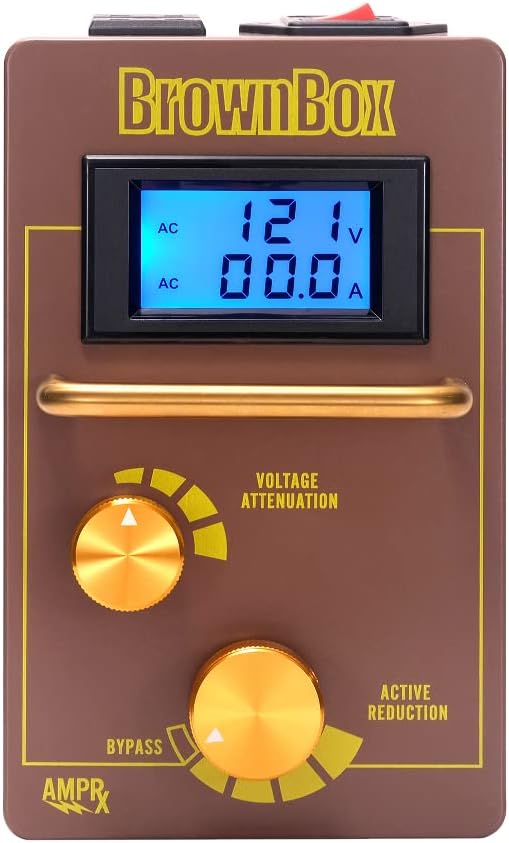
The BrownBox Tube Amplifier Input Voltage Attenuator offers a unique approach to amp protection and control. It holds a perfect 5.0 rating indicating user satisfaction with its performance. This unit focuses on regulating the AC voltage entering your amplifier rather than attenuating the audio signal.
We may earn a commission when you buy through this link, at no additional cost to you.
Its main benefit is protecting sensitive tube equipment from unstable mains power which can cause overheating or tone issues. The LCD voltmeter provides real-time monitoring of your input voltage ensuring your amp operates within safe limits. This is essential for vintage gear that expects specific voltage levels.
Users should note this is not a volume control for the audio output. It manages the power source to ensure consistent performance. This distinction makes it a specialized tool for protection rather than a standard attenuator for recording or quiet practice sessions.
If you own valuable tube amplifiers that require precise voltage conditions this device is an essential safety investment. It gives you confidence when using equipment in venues with unreliable power grids. Its robust build ensures it handles full-sized tube amplifiers with ease.
Regulating input voltage prevents tone drift and protects internal components from stress.
The built-in LCD provides immediate feedback on your electrical environment status.
We may earn a commission when you buy through this link, at no additional cost to you.
The Tone King Ironman II Mini is a high-performance reactive power attenuator designed for serious players. With a rating of 4.6 stars it proves its worth in maintaining natural amp dynamics even at lower volumes. It handles up to 30 watts making it suitable for most mid-wattage tube heads.
We may earn a commission when you buy through this link, at no additional cost to you.
Its standout feature is the reactive load circuit which preserves the complex interaction between your amp and speaker cabinet. The included line output allows you to send a direct signal to your interface while the footswitchable boost adds versatility to your live tone. This makes it a versatile tool for both practice and recording.
One limitation is that it operates at 8 ohms which might not match all setups without a transformer. However for those with compatible gear the convenience of having both attenuation and boost in one pedal is significant. The price reflects the high-quality components used in the design.
This unit is ideal for players who need to keep their tone reactive and alive while playing at reasonable volumes. It is a step up from simple resistive attenuators and offers greater fidelity. If you want a compact yet powerful solution this model delivers.
Reactive circuitry keeps the amp happy and preserves its natural frequency response.
The footswitchable boost adds extra punch when needed without a separate pedal.
We may earn a commission when you buy through this link, at no additional cost to you.
The Donner Amp Attenuator Pedal provides an accessible entry point for players seeking volume control. It has a rating of 4.3 stars which indicates good satisfaction for its price point. This device focuses on keeping your tone clear and pure while allowing you to push your amp hard.
We may earn a commission when you buy through this link, at no additional cost to you.
Its main strength lies in the true bypass design and high-quality electronic components that maintain signal integrity. The mute footswitch is a thoughtful addition allowing for instant silence during transitions. The compact design fits easily into any pedalboard setup without taking up excessive space.
A trade-off is the requirement for an external DC 9V adapter which is not included. This adds to the setup complexity slightly compared to passive units. The attenuation is straightforward without advanced reactive features which limits its fidelity compared to premium options.
This pedal is perfect for beginners or budget-conscious players who need a reliable way to practice at home. It effectively tames the volume without ruining the core tone of your amp. If you need a simple mute and volume control tool this offers excellent value.
True bypass ensures your tone remains untouched when the unit is not engaged.
The dedicated mute switch lets you silence the signal instantly with a tap.
We may earn a commission when you buy through this link, at no additional cost to you.
The Two Notes Torpedo Captor serves as both a reactive load and a direct box for your guitar rig. It holds a rating of 4.5 stars reflecting its popularity among studio musicians. This unit is designed to help you record your tube amp directly into your interface without a speaker cabinet.
We may earn a commission when you buy through this link, at no additional cost to you.
Its key strength is combining attenuation with a direct output that is ready to go into a mixer or recorder. The reactive load helps maintain a realistic load for your amp even when a speaker is not connected. This is a practical choice for home studios needing silent recording capability.
While it functions as a loadbox it lacks the extensive cabinet simulations found in higher-end models. You might need to pair it with external plugins to get the perfect sound. This keeps the cost lower but requires a bit more effort to dial in your final tone.
If you want to record guitar quietly while using your favorite tube amp this device bridges the gap effectively. It protects your amp while giving you a clean signal to work with. It is a great mid-range solution for practical recording needs.
Eliminate cabinet noise while capturing the direct tone of your amplifier.
The reactive load ensures your amp sees a proper impedance for safety.
We may earn a commission when you buy through this link, at no additional cost to you.
The Universal Audio Ox Amp Top Box represents the pinnacle of guitar recording technology. With a 4.4 rating it delivers a no-compromise analog reactive load experience. It allows you to capture album-quality mic tones directly from your tube amp without physical microphones.
We may earn a commission when you buy through this link, at no additional cost to you.
Its standout quality is the UA Dynamic Speaker Modeling which emulates drive breakup and cone cry accurately. The front panel RIG control gives you instant access to virtual mic positions and cabinet sounds. Five finely-tuned attenuation levels let you play at any volume from silent to full band.
A major trade-off is the high price point which makes it an investment for professionals. It also requires a bit of learning to master the RIG and modeling features fully. However for those needing the best possible tone without a mic setup it justifies the cost.
This unit is best for serious home studio owners who demand top-tier tone from their gear. It eliminates the guesswork of miking and delivers consistent results every time. If you want the ultimate recording interface for your tube amp this is the tool.
Access dozens of mic positions and cabinet tones with a simple turn of a knob.
Adjust volume across five levels to match any playing environment or session.
We may earn a commission when you buy through this link, at no additional cost to you.
The Warm Audio Reamper Routing Hub is designed for the recording studio workflow. It offers a solid build and versatile routing options for processing your guitar tracks. This device allows you to route signals through independent preamp paths for flexible sound sculpting.
We may earn a commission when you buy through this link, at no additional cost to you.
Its main strength is the ability to manage reamping sessions efficiently. The variable impedance control gives you the freedom to tweak how your amp responds to the reamped signal. This makes it a powerful tool for producers looking to get the perfect tone for a mix.
While it includes a silent power soak it is not designed as a primary attenuator for playing volume. It is more of a studio utility hub than a practice tool. This specialization means it excels in recording scenarios but might be overkill for simple home practice.
If you are a studio musician or producer who needs robust routing capabilities this unit is a great addition. It enhances your workflow and provides options for creative tone shaping. It pairs well with other studio gear to expand your recording possibilities.
Route your signals through separate preamp paths for unique processing opportunities.
Control the input impedance to shape how your reamped tones sound through the amp.
We may earn a commission when you buy through this link, at no additional cost to you.
The Tone King Ironman II 100W is built for high-powered tube amplifiers. With a 4.2 rating it handles the demands of full-range heads with precision. This unit is a precision-compensated reactive power attenuator designed to keep your tone intact even at low volumes.
We may earn a commission when you buy through this link, at no additional cost to you.
Its standout feature is the ability to handle 100 watts making it compatible with most high-power setups. The built-in cabinet simulation and DI output simplify recording by removing the need for a cabinet and mic. The presence switch lets you tweak your tone for better clarity on the go.
The weight is a consideration as this is a substantial piece of gear compared to pedalboard units. Additionally the higher price reflects the specialized engineering required for high-wattage handling. These are minor compromises given the performance it offers for heavy hitters.
This attenuator is ideal for players who use 50W to 100W tube amps and need reliable volume control. It ensures your amp performs safely without the massive volume of a full band setup. It is a professional choice for those needing power and fidelity.
Designed specifically to manage the heat and output of high-powered tube heads.
Record directly into your interface with a built-in cabinet simulation.
We may earn a commission when you buy through this link, at no additional cost to you.
The Boss WAZA Tube Amp Expander is a first-of-its-kind command center for tube amplifiers. With a 4.3 rating it delivers advanced features that set it apart from standard attenuators. This unit uses discrete analog components to support tube amps up to 150 watts.
We may earn a commission when you buy through this link, at no additional cost to you.
Its key strength is the user-adjustable impedance tuning which matches the reactive load to your amp perfectly. This retains the natural dynamic feel and distortion characteristics of your gear. The ten recallable rig settings allow you to switch between presets instantly using MIDI or footswitches.
The high cost and large footprint are significant trade-offs for this level of sophistication. It requires a serious commitment to integrate fully into your rig. However for users who want total control over their tone and volume it is unmatched.
This expander is best for advanced players and studios who need maximum flexibility and precision. It transforms your amp into a versatile instrument capable of adapting to any venue. If you demand the best control this system is a top-tier choice.
Adjust the impedance to ensure your amp reacts exactly as it was designed.
Store up to ten rig settings to recall your favorite setups instantly.
We may earn a commission when you buy through this link, at no additional cost to you.
Selecting the right attenuator involves understanding your amplifier's needs and your specific use case. This section explores the key factors to consider before making a purchase.
Ensure the attenuator can handle the total wattage of your amplifier. A unit rated too low may overheat or fail when pushing a high-powered tube amp. Always check the maximum wattage rating against your amp's output to ensure safety.
Match the power handling to your specific amp model to prevent damage and ensure longevity.
Your attenuator must match the impedance of your amplifier and speaker cabinet. Most units support 4 8 and 16 ohm connections. Incorrect matching can cause tone issues or potential damage to your amplifier's output transformer.
Verify that the input and output connectors align with your gear's requirements.
Reactive loads mimic the complex impedance curve of a real speaker which preserves tone and dynamics better. Resistive loads are simpler and cheaper but can sound flatter or thinner. Choose reactive if you want to retain the full feel of your amp.
Reactive models are generally preferred for preserving natural speaker interaction and compression.
Look for features that add value to your workflow such as direct outs for recording or built-in speaker simulations. Some units offer boost controls or tone shaping options that enhance versatility. These features can save you from buying extra pedals or rack gear.
Prioritize features that align with your recording and performance needs.
Since attenuators handle high power and heat they need robust construction. Look for metal enclosures and heat dissipating components that ensure reliability. A sturdy build will withstand the rigors of touring and regular use.
Invest in units with proven durability to avoid frequent replacements or repairs.
If you plan to record directly into an interface look for a unit with a high-quality DI output. Some advanced attenuators include virtual mic positions to bypass miking entirely. This can streamline your recording setup and save time.
Check for balanced XLR outputs and built-in speaker emulators for silent recording.
Attenuators range from affordable pedals to expensive rack units. Determine your budget and find the best features within that range. Often a simple passive unit is enough for practice whereas recording requires more advanced active features.
Balance the cost against the utility the unit provides for your specific situation.
Connect your tube amp's speaker output to the input of the attenuator using a high-quality speaker cable. Then connect the attenuator output to your speaker cabinet or load box. Ensure the impedance settings match on both the amp and attenuator.
Set the attenuation level based on your desired volume. Start with a high attenuation setting to reduce volume to a whisper before adjusting up for your target level. This protects your ears and your room from excessive noise.
Allow the attenuator to cool down after long sessions as high heat can degrade internal components over time. Store it in a dry place away from direct heat sources to ensure it lasts for years of reliable use.
While master volumes allow for lower listening levels they often thin out the tone of the preamp. An attenuator lets you push the power tubes to saturation while controlling overall output. This results in a richer and more dynamic sound than using a master volume alone.
Attenuators designed for tube amps may not work correctly with solid state amplifiers. Tube amps rely on speaker impedance load interaction which solid state amps handle differently. Check manufacturer recommendations to ensure your attenuator is compatible with your specific amplifier type.
Simple resistive attenuators can slightly degrade tone but high-quality reactive models minimize this loss. Some units even improve tone by preventing excessive power tube sag. Using a good attenuator often yields better tone than cranking an amp to max volume.
A load box is typically a reactive load designed to replace a speaker cabinet for silent recording. An attenuator is designed to reduce volume while driving a cabinet. Some modern units combine both functions into a single device for maximum versatility.
Many modern attenuators include a direct out that allows you to record without a microphone. These outputs often feature speaker emulation to shape the signal for a studio-ready tone. Always check if the unit has a balanced XLR output for best results.
Passive attenuators generally do not add noise because they have no active electronics. Active attenuators might introduce noise if they have power supplies or complex circuitry. Choosing a reputable brand with high-grade components minimizes any potential noise floor.
We have reviewed ten top-rated options ranging from budget-friendly pedals to premium studio recorders. The Bugera POWER SOAK PS1 and Donner Amp Attenuator Pedal stand out for their specific value propositions in the market.
Prioritize reactive load models if you want to preserve the natural feel of your tube amp. Also consider your recording needs to decide if you require direct outputs or advanced speaker simulations.
Prices and availability change often so please check current listings before making your final purchase. Ensure you verify the wattage ratings match your specific equipment to guarantee safe operation.