
KAIWEETS Digital Clamp Meter
4.5Editor score
D-shaped jaw design
True-RMS AC DC
Flashlight included
This guide compares ten top-rated digital clamp meters for 2026, evaluating accuracy, safety ratings, display quality, and features to help professionals
Digital clamp meters are essential tools for electricians and technicians who need to measure electrical current safely without interrupting the circuit. These devices combine the functionality of a multimeter with a clamp jaw for convenient current measurement.
We evaluated ten leading models based on accuracy, safety ratings, display readability, and feature sets. Our analysis covers auto-ranging capabilities, True RMS technology, and additional functions like temperature and capacitance measurement.
Each pick highlights specific strengths for different use cases ranging from home DIY to industrial maintenance. Please note that prices and availability change frequently so verify current details before purchasing your next tool.
4.5Editor score

4.8Editor score

4.7Editor score
The following table provides a side-by-side comparison of all ten selected digital clamp meters. This overview highlights key specifications including current capacity, voltage range, and safety categories to assist in quick decision making.


The Klein Tools CL120 stands out as a reliable choice for electricians needing a straightforward digital clamp meter. It holds an excellent rating for accuracy and ease of use in various electrical environments.
We may earn a commission when you buy through this link, at no additional cost to you.
Its auto-ranging technology ensures precise measurements without manual dial adjustments. The integrated non-contact voltage test in the jaw adds significant safety and convenience for quick checks.
While it lacks some advanced features like capacitance measurement, the core functions are robust. The backlit display ensures readability in dimly lit panels or outdoor settings.
This meter is ideal for professionals who value durability and essential functionality. It offers a balanced feature set that supports daily troubleshooting tasks effectively.
The non-contact voltage feature allows safe detection of live wires before physical contact. This reduces the risk of accidental shock during initial inspections.
Test leads and a magnetic hanger option keep your workspace organized. This design helps prevent lost accessories during field work.
We may earn a commission when you buy through this link, at no additional cost to you.
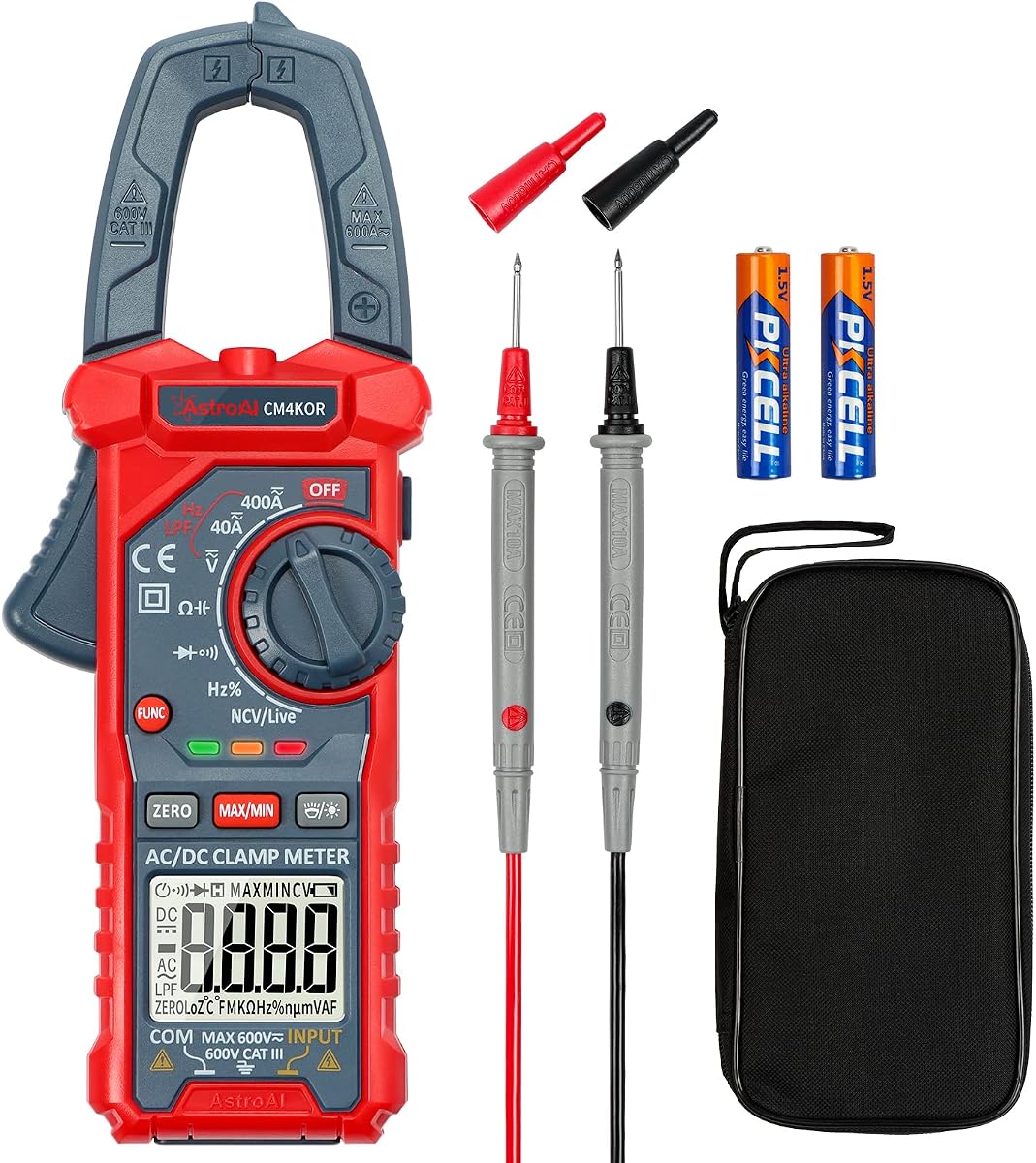
The AstroAI Digital Clamp Meter offers a surprising number of features for its price. It is well-suited for DIYers and hobbyists tackling household electrical projects.
We may earn a commission when you buy through this link, at no additional cost to you.
Functions like live wire testing and capacitance measurement expand its utility beyond basic current checks. The LCD backlight and flashlight assist in dark utility closets.
Some users report the auto-ranging can be slow in noisy environments. However, the manual range option provides a workaround for consistent readings.
For those seeking maximum functionality without a high cost, this model delivers value. It balances performance with accessibility for general electrical maintenance.
The live wire test identifies energized conductors without direct probe contact. This feature is useful for verifying circuits before working on panels.
The slim profile allows the meter to fit into tight spaces between components. This is beneficial when working in crowded control panels.
We may earn a commission when you buy through this link, at no additional cost to you.
The FNIRSI DMC-100 introduces a color TFT display and graphing features rarely seen in standard clamp meters. This makes it unique for troubleshooting intermittent electrical faults.
We may earn a commission when you buy through this link, at no additional cost to you.
Users can view real-time curves to analyze signal variations. The rechargeable battery eliminates the need for frequent AAA replacements during long shifts.
The interface has a learning curve compared to simpler rotary dial meters. However, the detailed data visualization aids in complex diagnostic scenarios.
This model is excellent for technicians who need to document and analyze trends. It bridges the gap between a basic meter and a data logger.
Stores historical data sets for later analysis. This helps track down issues that occur only under specific load conditions.
The bright screen ensures visibility even in direct sunlight. Adjustable brightness prevents battery drain in low-light settings.
We may earn a commission when you buy through this link, at no additional cost to you.
The Klein Tools CL390 is a robust meter designed for professionals who need AC and DC measurement capabilities. Its frequency and duty cycle functions make it versatile for HVAC systems.
We may earn a commission when you buy through this link, at no additional cost to you.
The reverse-contrast LCD provides excellent readability under various lighting conditions. True RMS technology ensures accuracy with non-linear loads like motor drives.
While it lacks non-contact voltage detection, the core electrical measurements are precise. The magnetic hanger option supports hands-free operation during testing.
This meter is a strong choice for HVAC and industrial electricians. It focuses on essential measurement functions with high reliability.
Measures both AC and DC current without needing separate tools. This simplifies troubleshooting for hybrid electrical systems.
Frequency and duty cycle measurements help analyze VFD outputs. This is critical for diagnosing motor control issues.
We may earn a commission when you buy through this link, at no additional cost to you.
The Fluke 302+ is renowned for its safety ratings and rugged construction. It is designed to protect users in potentially hazardous electrical environments.
We may earn a commission when you buy through this link, at no additional cost to you.
Its CAT IV rating provides confidence when working on service panels. The 30mm jaw accommodates large conductors found in commercial and residential systems.
It lacks some advanced features found in higher-end models but excels in core functions. The manual range dial ensures precise selection without ambiguity.
For professionals prioritizing safety and brand reputation, this is a top choice. It is a straightforward tool for reliable daily use.
The CAT IV 300V rating offers protection for outdoor and service entrance work. This reduces risk when dealing with main panels.
A 30mm opening fits standard bus bars and thick cables. This ensures compatibility with common commercial wiring sizes.
We may earn a commission when you buy through this link, at no additional cost to you.
The KAIWEETS Digital Clamp Meter features a unique D-shaped jaw that grips various cable types securely. It is an attractive option for homeowners and light commercial users.
We may earn a commission when you buy through this link, at no additional cost to you.
Safety features like NCV and LED warnings enhance user confidence during testing. The backlight and flashlight are practical for dimly lit electrical panels.
While not designed for heavy industrial abuse, it performs well for routine checks. The included carrying case protects the tool during transport.
This model offers a high return on investment for general electrical maintenance. It provides essential functions at a competitive price point.
The unique jaw shape accommodates round and flat cables easily. This reduces slipping and ensures accurate current measurement.
Visual and audible alerts warn when high voltage is detected. This proactive warning helps avoid accidental contact with live circuits.
We may earn a commission when you buy through this link, at no additional cost to you.
The Fluke-301D/ESP is designed specifically for accessing hard-to-reach areas. Its slim jaw fits into crowded junction boxes where other meters cannot fit.
We may earn a commission when you buy through this link, at no additional cost to you.
Despite its size, it maintains a 600A current capacity. The CAT III safety rating ensures reliability for typical commercial and residential work.
It focuses on core AC DC current and voltage measurements. This simplicity often results in faster readings and fewer errors.
Technicians working in confined electrical panels will appreciate the slim design. It offers a practical solution for difficult access points.
The thin jaw arm allows measurements between tightly packed wires. This capability saves time during complex troubleshooting tasks.
Fluke's reputation ensures the readings are trustworthy. Consistent performance is crucial for professional diagnostics and reporting.
We may earn a commission when you buy through this link, at no additional cost to you.
The Klein Tools CL220 combines standard clamp meter functions with temperature measurement. This dual capability is useful for motor and appliance diagnostics.
We may earn a commission when you buy through this link, at no additional cost to you.
True RMS technology ensures readings are accurate even when waveforms are distorted. The backlit display and integrated NCV support safe operation.
It is a versatile tool that reduces the need for carrying multiple devices. However, note that the thermocouple is not always included.
For HVAC and appliance technicians, this model offers a convenient workflow. It simplifies checking motor windings and heating elements.
Temperature readings help identify overheating issues early. This prevents costly equipment failures and unplanned downtime.
The jaw-mounted voltage sensor allows for quick checks. This eliminates the need to switch modes for safety verification.
We may earn a commission when you buy through this link, at no additional cost to you.
The Fluke 323 is engineered for the demands of commercial and residential electricians. It provides True RMS accuracy for non-linear loads typical in modern buildings.
We may earn a commission when you buy through this link, at no additional cost to you.
The audible continuity sensor speeds up wire tracing and circuit verification. Its CAT IV rating offers essential protection for service entrance panels.
It includes a soft carrying case to keep accessories organized. This thoughtful inclusion adds value to the professional package.
For electricians needing precise and reliable measurements daily, this model is a standard choice. It supports efficient troubleshooting in diverse environments.
True RMS provides correct values for non-sinusoidal currents. This is critical for modern electronic loads and VFD circuits.
A loud tone confirms a complete circuit instantly. This feature is indispensable for tracing wires behind walls.
We may earn a commission when you buy through this link, at no additional cost to you.
The Klein Tools CL460S features a Smart Mode that auto-selects measurement functions. This innovation streamlines testing and reduces manual dial adjustments.
We may earn a commission when you buy through this link, at no additional cost to you.
Its AC DC current and voltage capabilities cover a wide range of applications. The reverse-contrast LCD ensures visibility in direct sunlight.
The auto-ranging TRMS technology guarantees accuracy across all settings. However, new users may need time to trust the auto-select features.
This meter is ideal for modern electricians who want efficiency. It reduces errors and speeds up complex diagnostic workflows.
The meter detects the test leads and sets the correct mode. This automation minimizes the risk of selecting the wrong scale.
The transflective screen reflects ambient light for clear reading. This ensures visibility during outdoor solar panel inspections.
We may earn a commission when you buy through this link, at no additional cost to you.
Selecting the right digital clamp meter involves considering several technical and practical factors that align with your specific work requirements.
The primary function of a clamp meter is measuring current, so ensure the model supports the amperage you typically encounter. Residential work usually requires 400A capacity while industrial settings may need higher ratings. Voltage ratings should also match your environment to avoid damaging the meter or compromising safety. Always check both AC and DC capabilities since some jobs require testing battery circuits.
Choose a meter with capacity exceeding your typical load to ensure longevity and safety.
Safety ratings indicate the meter ability to withstand voltage spikes in specific electrical environments. CAT III is standard for distribution panels while CAT IV is required for outdoor service entrances. Ignoring these ratings can lead to dangerous accidents or equipment failure during faults. Always match the CAT rating to the highest point in the circuit you will test.
Verify the CAT rating matches your work environment to ensure personal protection and safety.
True RMS (Root Mean Square) technology provides accurate readings for non-linear loads such as computers and motor drives. Averaging meters may give incorrect values in these modern electronic systems. If you work with VFDs or harmonic-heavy circuits, True RMS is a critical feature to prioritize. It ensures your measurements reflect the actual power consumption and load.
Prioritize True RMS technology to ensure accuracy with modern electronic loads.
Auto-ranging meters automatically select the appropriate measurement scale which saves time and reduces dial errors. Manual ranging requires the user to guess the scale which can be slower but sometimes more precise for specific tasks. For field efficiency, auto-ranging is usually preferred but manual override offers flexibility for experienced users. Consider how often you test unknown circuits when deciding between these modes.
Select auto-ranging for speed or manual for specific precision requirements.
A clear display is essential for reading values in dimly lit panels or outdoor conditions. Backlights and contrast options help ensure numbers are visible in various lighting scenarios. Some meters offer color screens for better data visualization during complex troubleshooting tasks. A good display reduces eye strain and helps prevent reading errors during long shifts.
Look for backlit or high-contrast displays to ensure readings are visible in all conditions.
Many clamp meters offer extra functions like temperature measurement, capacitance, or frequency testing which can be useful for HVAC work. Non-contact voltage testing (NCV) is a valuable safety feature for checking live wires. Features like data hold or max/min tracking help capture fluctuating readings that occur briefly. Assess which extras align with your daily tasks to avoid paying for unused tools.
Include extra features like NCV or temperature only if they match your workflow.
The physical size of the clamp jaw determines the conductor size you can measure and the space you can fit into. Slim jaws are essential for tight junction boxes while large jaws are needed for thick bus bars. Some designs like D-shaped jaws offer flexibility for cables in different orientations. Ensure the jaw opening matches the typical conductor size you encounter.
Verify the jaw opening width accommodates the conductors you test regularly.
Professional tools should withstand drops and harsh environments so look for rugged construction. A warranty from the manufacturer indicates confidence in the product's reliability. Check if the case is included as this protects the meter during transport. Consider the reputation of the brand and availability of replacement parts like fuses.
Choose a meter with a solid warranty and durable build to withstand jobsite abuse.
Always start by inspecting the meter and test leads for damage before use. Never use a tool with cracked insulation as it poses a serious safety risk. Ensure the battery is fresh or charged to avoid mid-job failures.
To measure current, clamp the jaw around a single conductor not the whole cord. This isolates the magnetic field for accurate readings. For voltage or resistance, insert the test leads into the correct input jacks.
After use, clean the display with a soft cloth and store the meter in its case. Keep the jaws slightly open when storing to prevent spring fatigue. Avoid dropping the device or exposing it to extreme temperatures.
Some clamp meters can measure DC current while others only support AC. To measure DC you usually need a model with a DC setting or a specific clamp type. Check the specifications to ensure it supports both AC and DC if you work with batteries.
AC current changes direction periodically while DC flows in one direction only. Most household circuits use AC but electronics and vehicles use DC. Your meter must match the type of current you are testing for accurate results.
True RMS is not strictly necessary for simple resistive loads like lights. However modern electronics in homes create non-linear loads that standard meters may measure incorrectly. It is safer to choose a True RMS meter for general home electrical work.
A zero reading often means you clamped around both live and neutral wires together. The magnetic fields cancel out resulting in no current detection. Clamp around a single wire to get a correct reading.
Non-Contact Voltage testing detects the presence of AC voltage without touching the conductor. This feature acts as a quick safety check before using test leads. It uses sensors to pick up the electric field around the wire.
Most clamp meters have a battery compartment on the back secured by a screw or snap. Open the cover and insert the correct battery type such as AAA or CR2032. Ensure the battery door is sealed tightly to maintain safety ratings.
A carrying case protects the meter from drops dust and moisture during transport. It also keeps test leads organized so you do not lose them on site. Most professionals use cases to extend the tool lifespan and ensure safety.
Generally you cannot measure resistance with the clamp jaws directly. You must remove the test leads and connect them to the component. The clamp jaws are specifically designed for magnetic current measurement only.
The top picks highlight a range of options from budget-friendly models to premium industrial tools. The Klein Tools CL120 offers a balanced solution for most electricians while the Fluke 302+ provides unmatched safety for high voltage work.
Prioritize features that match your daily tasks such as True RMS or slim jaws. Investing in a quality meter ensures accuracy and safety which are vital for professional work.
Please note that product availability and pricing fluctuate regularly. Always verify current specifications and warranty terms on the official retailer site before finalizing your purchase.